What Are the Most Common Cancers? 

Cancer develops differently for everyone. We all have different genetics, lifestyles, habits, and food preferences, and these differences can lead to different cancer risks in various people.  

Timothy Rebbeck, PhD in his office. Photographed for POP SS 2019. Photo by Sam Ogden.
Tim Rebbeck, director of the Center for Global Health at Dana-Farber.  

“Cancer is a disease that can happen in anyone based on your family history, genetics, lifestyle, and environmental exposures,” says Tim Rebbeck, director of the Center for Global Health at Dana-Farber.  

Vital organs include the colon, which play a role in our digestive system, and the lungs, which help us breathe and deliver nutrients to our whole body. Colon cancer and lung cancer can form anyone with these organs.  

Common cancers in humans  

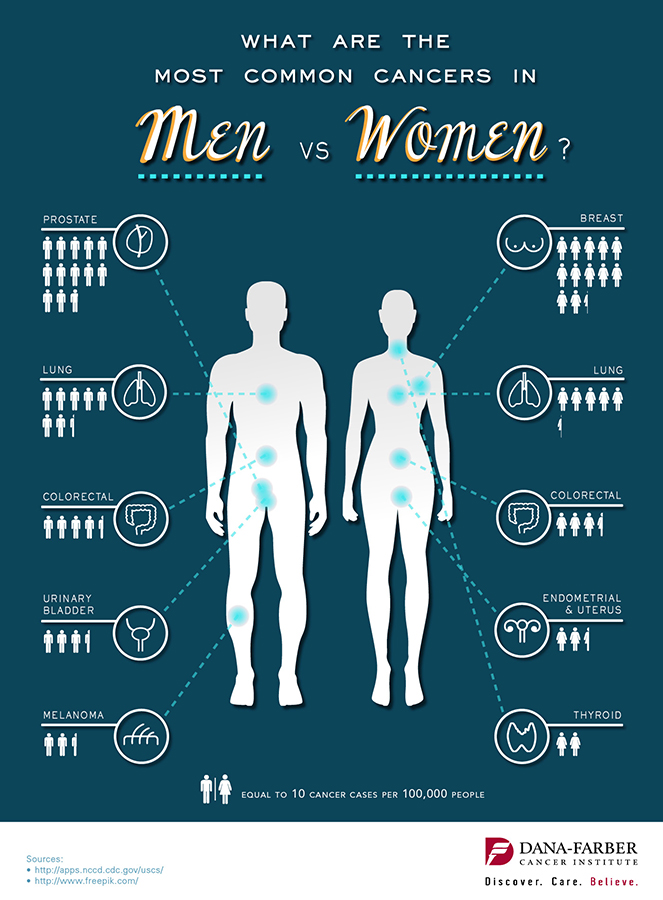
Cancer has the potential to grow in any of our organs, but some are more common than others. The most common cancers include: 

Colorectal cancer 

Colorectal cancer can begin as a result of an abnormal growth, such as a polyp, that becomes cancerous over time.  Factors like genetic predispositions, age, or lifestyle choices influence these risks. This disease is very treatable when detected early — for example, when polyps are detected and removed during a colonoscopy. Learn more about how Dana-Farber treats colorectal cancer. 

Lung cancer 

Lung cancer makes up about 12 percent of diagnosed cancer cases in Americans and is a leading cause of cancer-related deaths. There are many different types of lung cancer, but the most common type is non-small cell lung cancer, which begins when abnormal lung cells form inside the lining of the lungs and eventually form a tumor. 

Firsthand or secondhand cigarette smoking are the major reasons someone will develop a non-small cell lung cancer. Learn more about how Dana-Farber treats lung cancer. 

Melanoma 

Melanoma is one of the most dangerous forms of skin cancer, often caused by excess exposure to ultraviolet (UV) light found in sun exposure. Some of the first signs include a change to your skin, such as a new mole or a new, abnormal growth that is not uniform in shape and features dark pigmentation. Learn more about how Dana-Farber treats skin cancer. 

Thyroid cancer 

The thyroid plays a role in regulating the body’s metabolism and releases hormones that help control blood pressure, weight, and other variables like our heart rate. Thyroid cancer can form when the cancer cells in the tissues of the thyroid gland grow abnormally. 

While this cancer can arise in anyone, it is significantly more common in women who are generally diagnosed at the age of 40 to 50. Risk factors could stem from possible radiation exposure, a family history of the disease, and a history of an enlarged thyroid. Learn more about how Dana-Farber treats thyroid cancer. 

Common cancers by anatomy 

Bladder cancer 

In Bladder cancer, like other cancers, the cells in the bladder can grow abnormally and uncontrollably. About 1 in 28 men and 1 in 89 women have a chance of developing bladder cancer, according to the American Cancer Society. Of the new cases of bladder cancer, generally individuals over the age of 55 are at higher risk. Learn more about how Dana-Farber treats bladder cancer. 

Breast cancer 

Breast cancer begins when the cells grow uncontrollably or abnormally in breast tissue. Most commonly, cancer cells will form in the breast ducts, lobules or milk-producing glands, or the fatty tissue around the ducts and lobules.  

The most common symptom of breast cancer is a mass or lump, which is generally found through diagnostic tools like a mammogram, MRI, or biopsy.  “Breast cancer is found in both men and women but is substantially more common in women — it’s one of the leading cancers in women,” Rebbeck says.  

Learn more about how Dana-Farber treats breast cancer. 

Endometrial cancer 

Endometrial cancer occurs when malignant cancer cells form in the endometrium, the lining of the uterus. The risk of this cancer in women tends to increase with age or in those who have a genetic disposition, are overweight, or have conditions like polycystic ovarian syndrome.  

Learn more about how Dana-Farber treats endometrial cancer. 

Prostate cancer 

Prostate cancer is one of the most common cancers that occurs in people with a prostate. Prostate cancer can form in the tissues of the prostate, which is hidden below the bladder and near the rectum.  

While treatable if caught early, signs and symptoms could include blood in urine and/or changes in urination habits. Generally, men who are over the age of 55 have a higher risk of this disease. Learn more about how Dana-Farber treats prostate cancer. 

Early detection and care at Dana-Farber 

Early detection of cancer is important: finding cancer early means you are more likely to survive, so it’s important to stay up-to-date on annual check-ups with a medical professional.  

If you are diagnosed with any of these cancers, Dana-Farber can help.  

“We have treatment for every cancer, and we have specialty care that’s been designed around unique and unusual cancers. So, if you have a complex cancer case, we are here to help handle the complexity of the case and provide our patients with a comprehensive, holistic outlook,” Rebbeck says. “We discover the things that keep people healthy and keep people living their lives.”  

Consult with your doctor if you have a family history of cancer or have concerns about your health.  

1 thought on “What Are the Most Common Cancers? ”

  1. Think The most common cancer differs in each gender, however; prostate cancer and breast cancer are the most prevalent in men and women, respectively. Colorectal cancer and lung cancer, for example, are common cancers developed by both men and women.

Comments are closed.